How to play
A two player card game. Each player builds three routes of cards and tries to sell two of them. The full rules fit on this page. If you prefer learning by doing, try the tutorial.
The goal
Each player has three routes, side by side. Your first route faces your opponent's first route, your second faces their second and your third faces their third. Each facing pair is a contest of its own.
A route's value is the total of its number cards. A route sells when its value is between 21 and 26 and it beats the route facing it, which must be lower or out of range. Sell two of the three pairs to win.
Setting up
- Each player has their own deck: the 52 cards of a standard deck plus 2 Jokers, 54 cards in all.
- Both decks are shuffled and each player is dealt 8 cards. Nobody else sees your hand.
- Who goes first is decided at random. After that, players take turns.
The opening
Your first three turns start your routes. On each of them you place one number card, an Ace or a 2 to 10, on one of your empty routes, until all three have a card.
- During the opening you cannot play face cards, discard or disband.
- You do not draw during the opening, so after it you hold five cards.
- In the rare case that you hold no number card at all during the opening, you may discard one card and draw a replacement instead.
Your turn
After the opening, on each turn you do exactly one of these:
- Play a card. A number card goes on one of your own routes. A face card goes on a number card in any route, yours or your opponent's.
- Discard a card. Put one card from your hand on your discard pile.
- Disband a route. Clear one of your own routes. All its cards go to the discard pile.
After playing or discarding, you draw one card from your deck, so your hand stays at five cards until your deck runs out. Disbanding uses no card, so you do not draw.
Number cards and direction
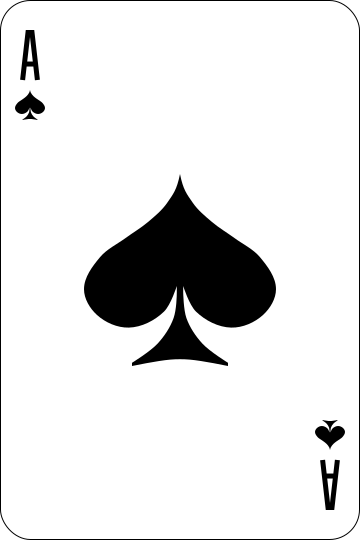
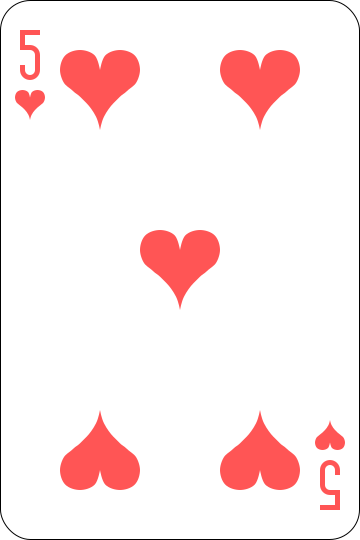
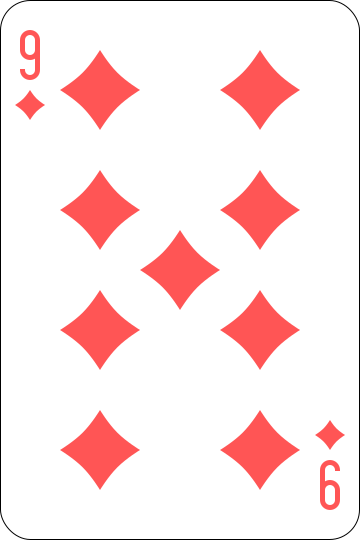
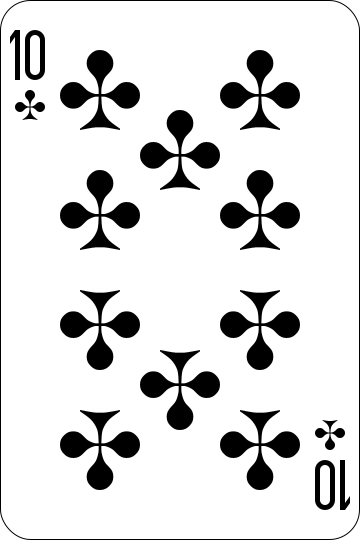
An Ace counts 1. Cards from 2 to 10 count their number. Face cards and Jokers add nothing by themselves.
- Any number card can start an empty route.
- The second card sets the route's direction. If it is higher than the first, the route is going up. If it is lower, the route is going down. Gaps are fine, a 3 can follow a 9.
- Every later card must keep going the same way: higher on a route going up, lower on a route going down.
- Exception: a card of the route's current suit may be played whichever way it goes. The direction then follows the last two cards, so it may turn around.
- You can never play the same value twice in a row on a route, not even with the same suit.
- The current suit is the suit of the route's last card, unless a Queen on that card says otherwise.
- If a Jack or Joker leaves two equal cards at the end of a route, it counts as going down.
Each route shows its total, an arrow for its direction and its current suit.
Face cards
Face cards attach to a number card. You may play them on your own routes or your opponent's. A number card can hold at most 3 face cards, and a full card can't take another, not even a Jack.
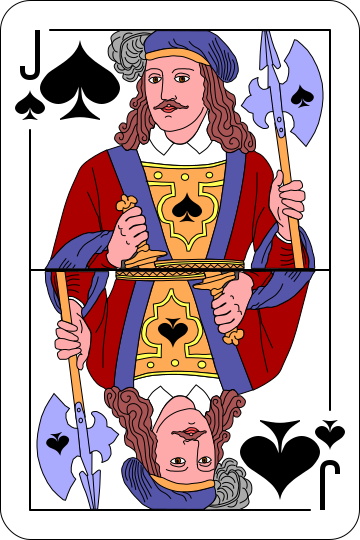
Jack
Removes the number card it is played on, together with everything attached to it. The Jack goes too.
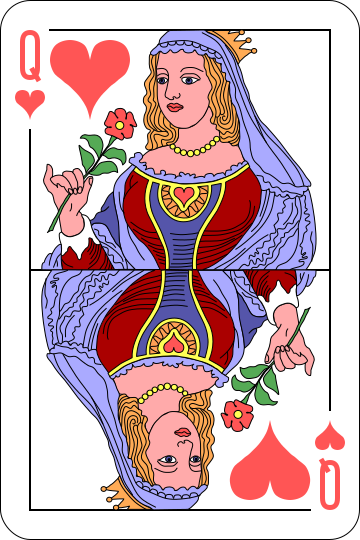
Queen
Played on the last card of a route. It reverses the route's direction and changes its current suit to the Queen's suit. Several Queens can stack, each one reverses again.
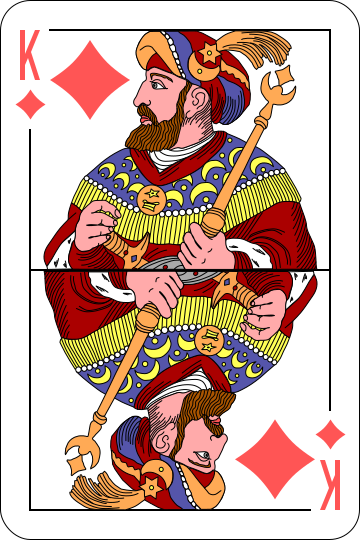
King
Doubles the value of the card it is on. A second King doubles it again, so a 5 with two Kings counts 20.
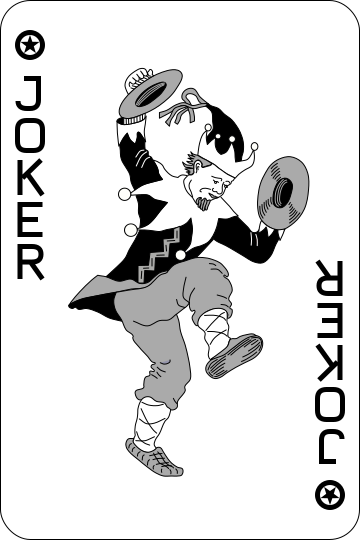
Joker
On an Ace: removes every other number card of that suit from the whole table, Aces included. On a 2 to 10: removes every other card of that value, any suit, from the whole table. The card the Joker is on stays, with anything attached to it. Face cards on removed cards go with them.
A face card adds no value of its own. A Joker on a route never counts as a card of any suit.
Selling a route
- A route between 21 and 26 can sell. Below 21 it is too low, above 26 it is overloaded.
- If both routes in a pair are between 21 and 26, the higher one sells.
- If only one of them is in that range, it sells.
- If both have the same value, neither sells until the tie is broken.
A sale is not final until the game ends. Your opponent can still knock a route out of range with a King, a Jack or a Joker.
Winning
- The game ends as soon as every pair has a route that sells. The player who sells two or three of the pairs wins.
- If you run out of cards, with nothing left in your hand or your deck, you lose straight away.
- In timed games you lose if your clock runs out. You can also resign.
- Against a person, each player has a minute for their first move, or the game is cancelled. A player who leaves for a minute, or takes five minutes over a move in an untimed game, loses.
Variants
Fans play this kind of game in slightly different ways. The Standard rules above are the ones used for rated games. The Variants below are other readings and popular house rules. They are clearly labelled, played for fun and never rated.
Queens Anywhere Casual
A Queen may go on any number card. It only turns the route around and changes its suit while it sits on the route's last card.
Kings Add Casual
A King adds the card's value once more instead of doubling it. A 5 with two Kings counts 15, not 20.
Founding Suit Casual
A route's suit is the suit of its first card, not its last. Queens still change it.
No Attachment Limit Casual
A number card can hold any number of face cards, not just three.
Quick Sale Casual
The first player to sell two routes at the same moment wins straight away, without waiting for the third pair.
Reshuffle Casual
When your deck runs out, your discarded cards are shuffled into a new deck. This can happen twice per player, so games still end.
Short Deck Casual
Each player gets a random 30 card deck from a full one, so games are quicker and less predictable.
Double Deck Casual
Each player shuffles two full decks together. Duplicates make Jokers far more dramatic.
Queen's Shield Casual
A Joker on an Ace leaves alone any card that has a Queen on it, because the Queen has changed its suit.
Steady Course Casual
When a Jack or Joker leaves two equal cards at the end of a route, the route keeps the direction it had before.
Fresh Hand Casual
A starting hand with fewer than three number cards is shown, shuffled back and dealt again.
Sheltered Joker Casual
A Joker never removes cards from the route it is played on. Everything else works as usual.
Terms of Service | Privacy Policy | Cookie Policy | Refund Policy | Community Guidelines | Caravaneer VIP | Contact | Status